The Marketer's Decade | Part II


In the pre-Claude Code era, I did a brief stint at a gaming company in India, building real-money gaming apps for the country. I was a growth product manager, which meant working very closely with the marketing team. Our KPI was simple to say and hard to move: get more people to play cash games, when plenty of free games were already a tap away.
To add some context: real-money gaming in India was rightfully regulated. But it made product work hard in ways I hadn't anticipated. For example: you could not talk to your users. No interviews, no asking what's going wrong, in case something sensitive slipped out. So I was at a company with an amazing product and a lot of process around it. Every change went through several layers of seniors, and of course legal and compliance.
But the company made one thing very easy. It gave us an experimentation platform that let my marketing team and me set up simple drag and drop frontend experiences fast, without needing an engineer. We couldn't ask users what they wanted, but we could see how they interacted with the product. We wrote hypotheses, tested them, and learned what worked and what didn't.
Every week or two, we'd take the latest results back to the drawing board with the marketing team, drag and drop a new experience together, and get it in front of players as soon as we could. That loop moved our KPI faster than anything else we tried.
That was my first taste of the power of experimentation. Needless to say, I was hooked. That was also a big part of why I joined Auxia. Auxia is building a global platform which lets marketing teams run hundreds of experiments simultaneously, one-to-one, for every customer, and the chance to build at its core excited me. But Auxia gave me something even more powerful as a product manager: AI. And yes, it has made me feel powerful, but mostly it has made it possible for me to chase more answers, test more ideas and follow more hunches than ever before.
In Part I, I argued that this is the marketer's decade: when every brand sounds the same, the people deciding what's worth saying become the difference. But being relevant is about speed too. A customer's needs move week to week, and a message that was right in March is noise by May. The marketers who make the most of this moment won't be the ones with the perfect plan. They'll be the ones who keep pace by working iteratively. Making marketing iterative is the next big lever, and the marketers who learn fastest will be the ones who win.
What AI already did to software
Look at what AI did to software. When code became cheaper to write, teams stopped agonizing over the perfect version and started shipping, watching and fixing, sometimes several times a day. Content followed a similar path. Now that a first draft takes seconds, the real work has moved to editing, choosing and refining.
In both cases, the cost of trying something collapsed. The winners used that to experiment more, not simply produce more of the same.
Product teams spent decades learning the hard way that nobody gets it right the first time. Marketing finally has the raw material to work the same way: rich behavioural data, the ability to create and ship variations affordably at scale, and systems that can measure what worked, and for whom. Habits that once we could only dream of are becoming part of everyday marketing craft.
Marketing's turn to iterate
But too much of marketing still runs in one big batch: brief it, build it, approve it, send it, then wait for the post-mortem. The best marketers we've been working with are already operating differently. They start with the customer's problem, not the campaign calendar. They work with hypotheses ("lapsed users respond to progress, not discounts") rather than certainties. They ship something small, watch what happens, and change it next week instead of next quarter.
What this looks like for a marketer
Honestly, you're already most of the way there. You know your customers better than almost anyone in the building, you can tell when a message feels off before it goes out, and you've been running tests for years. What changes is how often you get to use those instincts.
The thing that stuck with me from my gaming days is that every experiment was really a conversation. I couldn't call up a single player and ask why they weren't trying cash games, so I asked through the product instead, and they answered with what they did. You can have that conversation with a million people at once.
And the most interesting questions still start with you. Should this message lead with progress or with a discount? Should it land right after someone's first win, or a week later? Should it come from the brand, or from a friend who's already playing? A model can suggest answers and test them at scale for you. But you decide which questions are worth running, so the more it can test, the more your judgment matters.
You also don't need one perfect launch. Run a handful of small tests, look at what comes back, change course next week. Each round teaches you something you carry into the next one, and over a few months that adds up to knowing your customers in a way no research deck ever could.
These days AI can write ten versions of a message before your coffee goes cold. Picking the ones worth sending is still the fun part, and the critical one.
Put taste, judgment and an iterative mindset together, and you become a very powerful marketer. And every one of these shifts frees up more of your time for the part of the job you got into marketing for in the first place: understanding people and deciding what's worth saying.
The catch
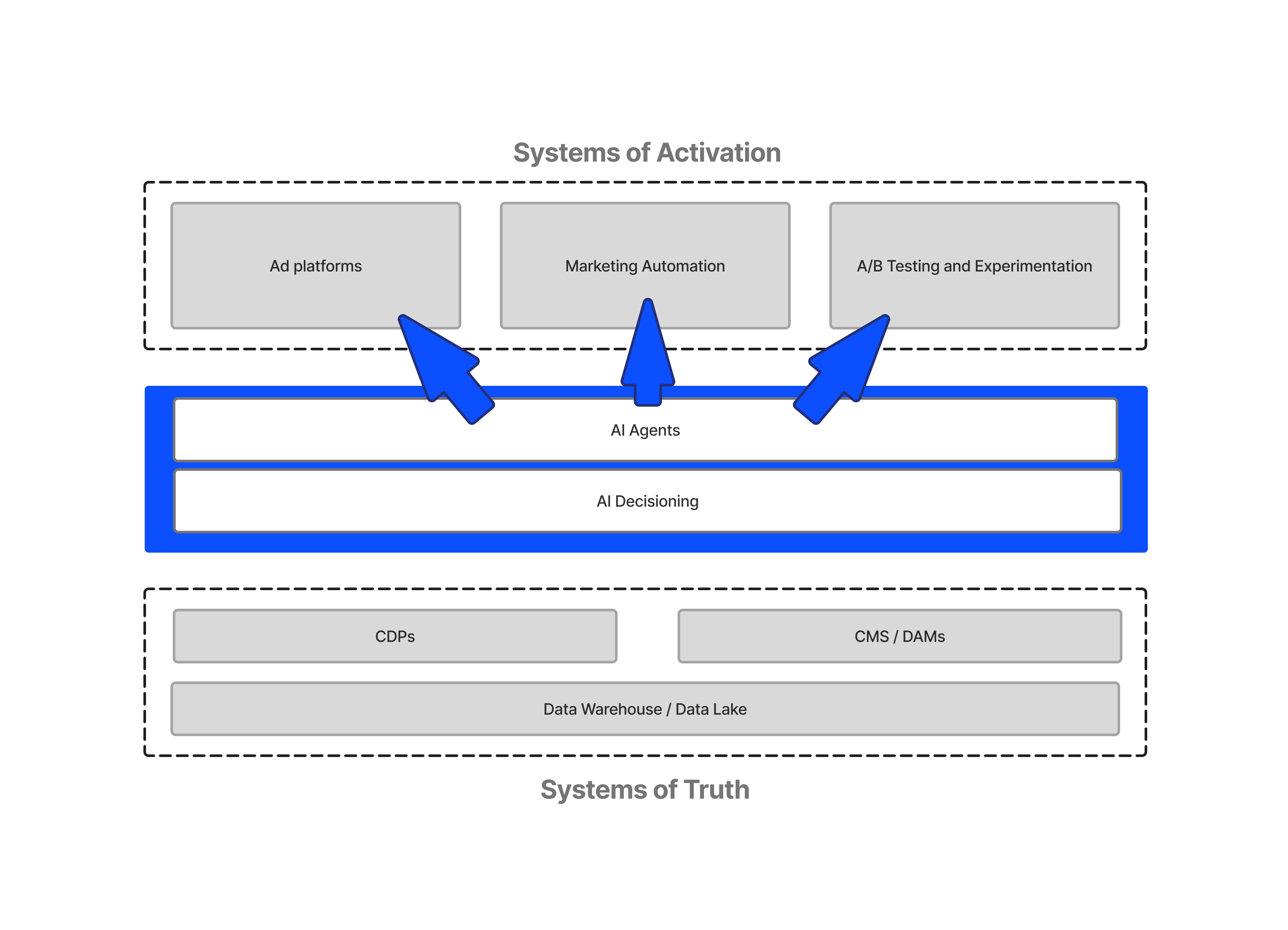
There's a catch, though. You can only be truly iterative if the systems around you move at the speed you do. You can have the right customer insight, the right hypothesis and the right message. But if every change still moves at the old pace, the moment has passed before the test even ships.
In Part III, I'm going to prove that speed and quality don't have to be opposites. I want to show what it looks like when you get both: every step you already rely on, just dramatically faster, from a hunch on Monday to a live test by Tuesday.